How I work
Short. Real. On your actual task, not a hypothetical.
The shape of an engagement
Most engagements go through four short stages.
1. A warm introduction. I don't cold-call. Someone you trust — a peer, a partner, a past client — mentions that I might be useful for something specific you're working on. You email me. We pick a time.
2. A 20-minute listening call. You describe one real thing you'd like to get done faster. No slides from me, no forms from you. If it's a fit, we book a working session. If it isn't, I'll tell you and usually point you somewhere better.¹ Median first call: 22 min. Range 12-45.
3. A working session on your real task. This is the part that makes the difference. Not a demo, not a hypothetical, not a canned use case. We share a screen over Google Meet and work on the actual thing. By the end of the session there is usually something tangible in your hands — a cleaned-up dataset, a working prototype, a scripted first pass at a stuck problem.² Median working session: 52 min. Range 30-90.
4. Follow-on sessions. Most engagements continue as a series of focused sessions, each one producing a concrete output. Some wrap up after a session or two. A few turn into longer collaborations.
The library of protocols
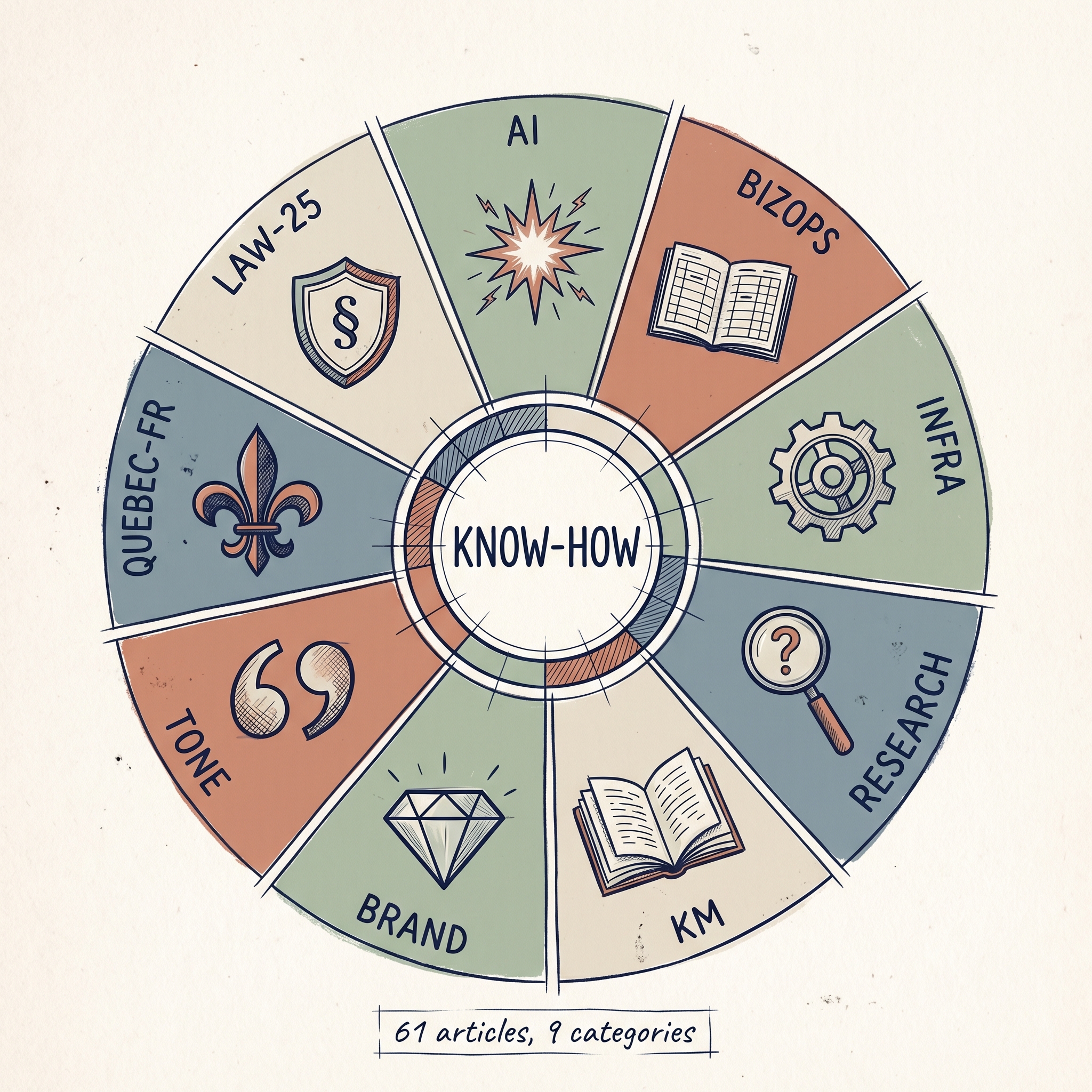
Most of the work you'd hire me for is a variation of something I've already done for my own businesses or for a previous client. I've built a private library of repeatable protocols — short documents describing how I handle a kind of job, what I charge for it, what the failure modes are, what the output looks like.³ 78 articles, 9 categories. Six AI agents reading from it, one inbox.
What I charge
I don't publish rates on the website. Here is what I'll tell you up front:
- Engagements are scoped and priced as a unit — not by the hour. The price depends on the shape of what we're trying to do and the depth of the engagement. It sits in the band you'd expect for a senior engineer with my background.
- Workshops are fixed price. The price includes the Workshop Prep Agent and the workshop itself. See the workshops page for the shape of those.
Why not publish prices? Because the work is short and shaped to your situation. A quick scoped engagement isn't priced the same way as a deeper build. I'd rather have a 20-minute call about fit than publish a single number that's wrong for your situation.
I've walked away from work where the shape didn't fit the price. Both directions.
Who I work with
Small and mid-sized businesses — the owner or a senior operator who feels the pain of a repeated manual task or is facing a tedious task and feels AI could do this.
Quebec and bilingual clients — I work in both English and Quebec French.
People I work with on larger jobs
I'm a one-person practice by default. For larger jobs I work with one or two trusted senior engineers — the current one is a fellow AI geek from Applied R&D who rebuilds websites with me. If a job needs someone I don't know, I'll tell you — and I'll either find the right person or recommend someone else and step out.
How to start
If what you've read here sounds like the right shape for what you need, one message is enough.
Tell me what you're trying to get done. A paragraph is plenty. I'll come back to you within a day or two with either a time to talk or a warm introduction to someone better suited.