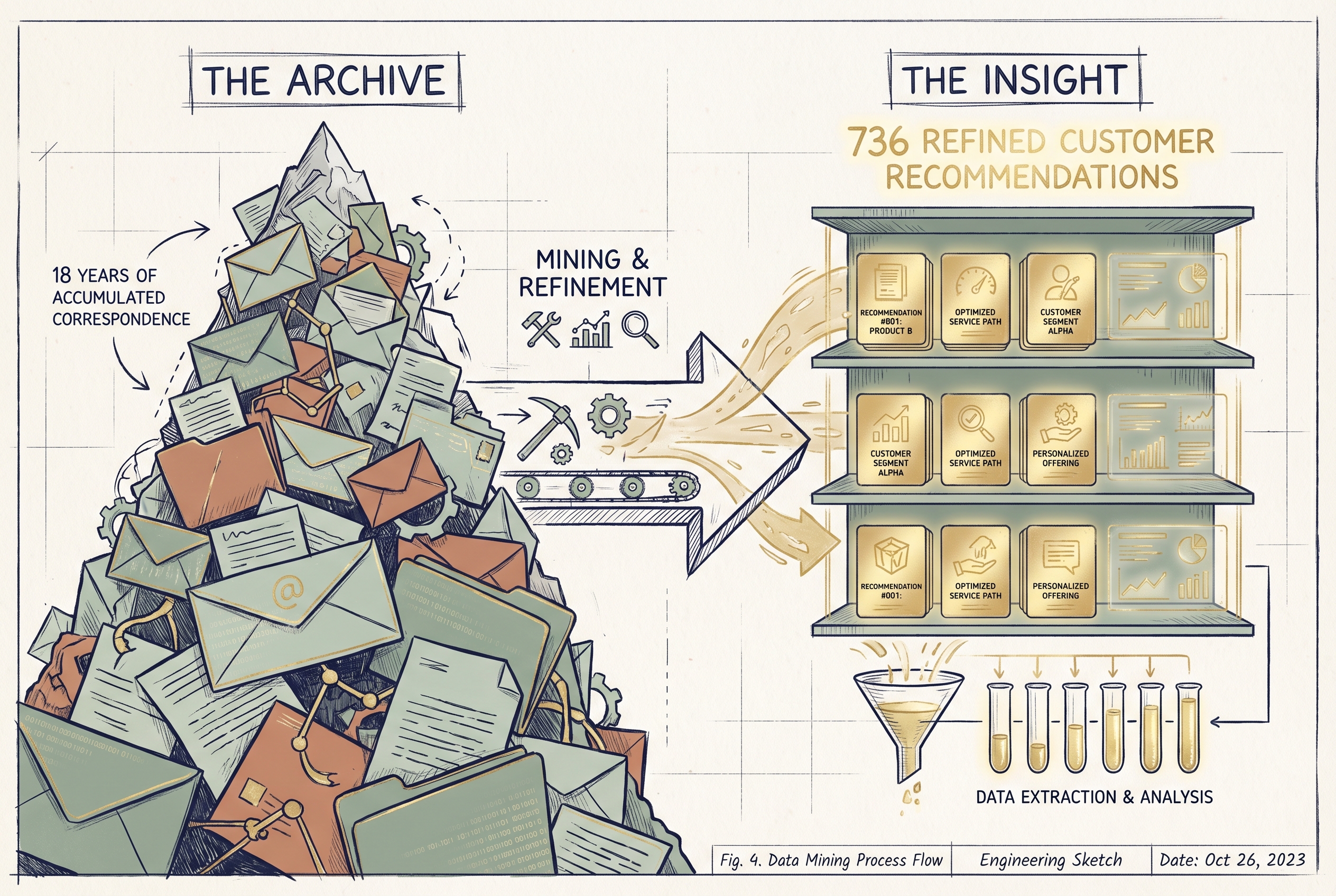
Eighteen years of email, turned into a pattern library
Over 500,000 messages in my email archive, filtered down to 736 high-signal customer recommendations — now a pattern library my sales and marketing partner's AI assistant queries live, every week.
What this could do for your organization
Most organizations have one or two people whose judgment is worth more than their role description suggests — the sales lead who scopes a proposal in five minutes and is right, the senior partner whose customer-email replies close more deals than anyone else, the department head who's seen every variant of a problem. That expertise lives in their head and their sent folder. When they retire, switch roles, or take a week off, the organization feels it.
This is the shape of what I do: I point a pipeline at that person's long-form archive — sent folder, CRM notes, consulting engagement logs, decision threads — and turn it into a searchable pattern library the rest of the team can reference without the expert in the room. Each pattern captures the structure behind a recurring judgment: the situation it applies to, what to recommend, the caveats and readiness conditions, the sequencing. A new hire, a successor, or an AI assistant sitting with a customer can all look up what the expert would have said — and why.
The practical effect: senior judgment becomes a durable asset of the organization, not a dependency on one person staying. And the pipeline can be rerun whenever the archive grows, so the library stays current.
What your team gets back
Three things come out the other side: a pattern library — every entry structured with the situation it applies to, the recommendation, the caveats, the sequencing, and when to use it; a pipeline your team can rerun on the archive as it grows, so the library stays current; and a pattern guide — the rules that govern how raw email gets turned into reusable structure, so adding a new pattern doesn't require guessing. The first extraction is the project; the library and the pipeline are what your organization keeps.
How I did it
For eighteen years I've answered the same recurring customer email at CoachingOurselves: a client describes their situation and asks which peer-learning topics we'd recommend. I've developed a careful style for those replies — validate their own picks, flag readiness-dependent topics, sequence the program. None of it was written down. It lived in my head and in my sent folder. In late March 2026 I pointed a pipeline at the archive and turned eighteen years of judgment into something my sales and marketing partner's AI assistant now queries live, every week.
The raw material: decades of expert judgment locked inside one person's sent folder.
The cheap pass collapses the haystack first. Only the survivors get the expensive treatment.
Body length × keyword count beats semantic similarity for finding actual worked examples.
The same words, restructured. Structure is what makes them findable when a different person hits a similar problem.
The library is the durable artifact. The expert's voice scales without the expert in the room.
The reusable part is the pipeline plus the pattern guide — cheap-first filtering, density scoring, hand-curated structure. It works on any senior expert's long-form archive: sales correspondence, consulting engagement logs, customer support histories, decision threads. The bottleneck isn't that the knowledge isn't there. It's that it's trapped in a format nobody else can search.
My sales partner at CoachingOurselves ran the same pipeline on his own emails. Then we pulled an export of our Salesforce data and every invoice we'd sent over the years, and let the Claude analyze the whole corpus — how each of us scoped proposals, how we priced, which patterns closed revenue and which ones quietly bled it. The Claude wrote two documents: one for me, one for him, each explaining what the other was doing that we could learn from. Two people who had worked together for years, discovering things about each other's judgment that had never been said out loud. Super useful.
If you're sitting on years of your own knowledge locked in email, this one isn't a one-session job — the pipeline needs to know what it's looking for before it starts pulling. We get on a call, you tell me what kind of knowledge you want extracted and what you'd use it for, and I scope out how much work the archive will take. Then we work through it together.
Related projects
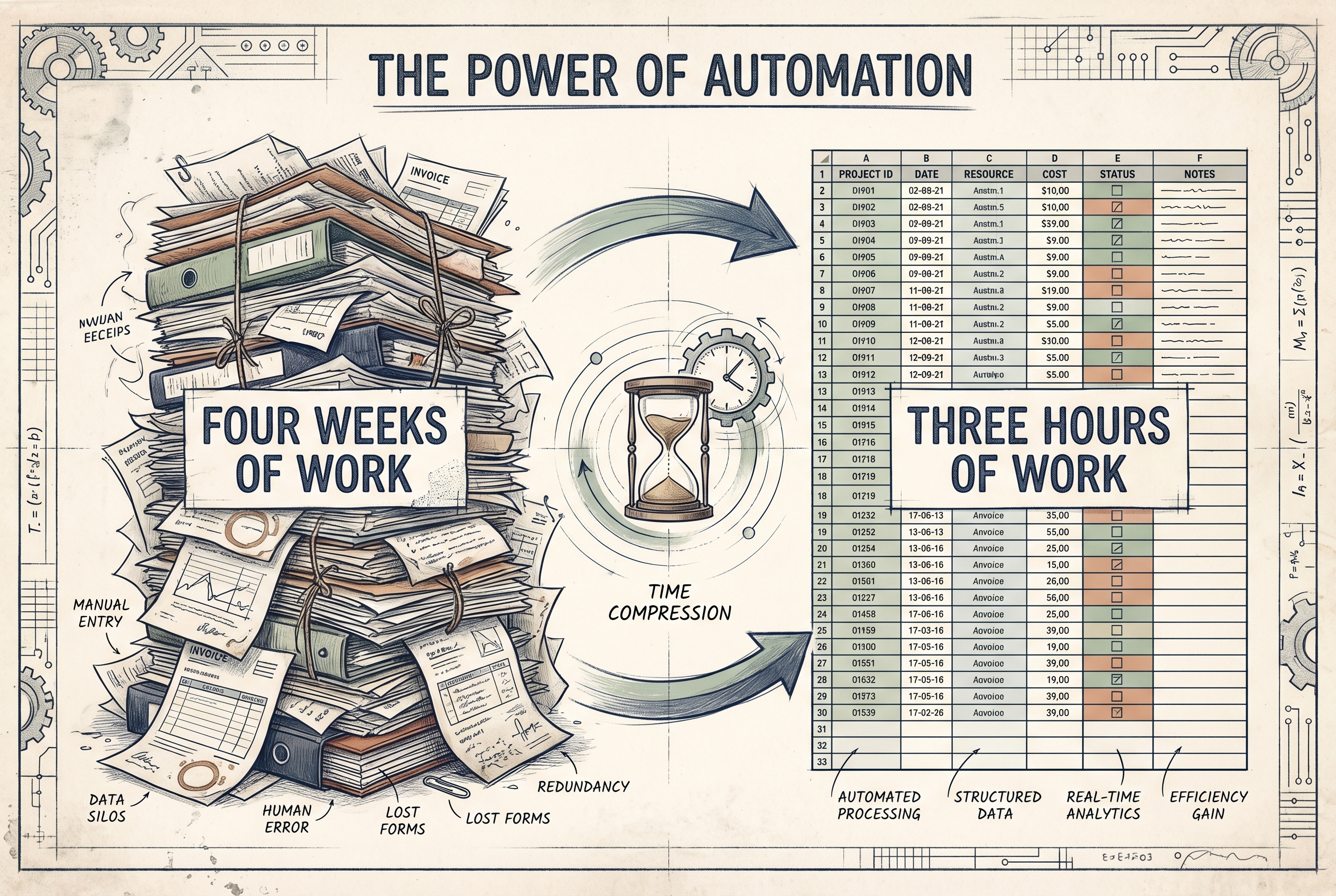
A month of work, three hours of work
Structured data, different domain, same cheap-first discipline.
Read the story →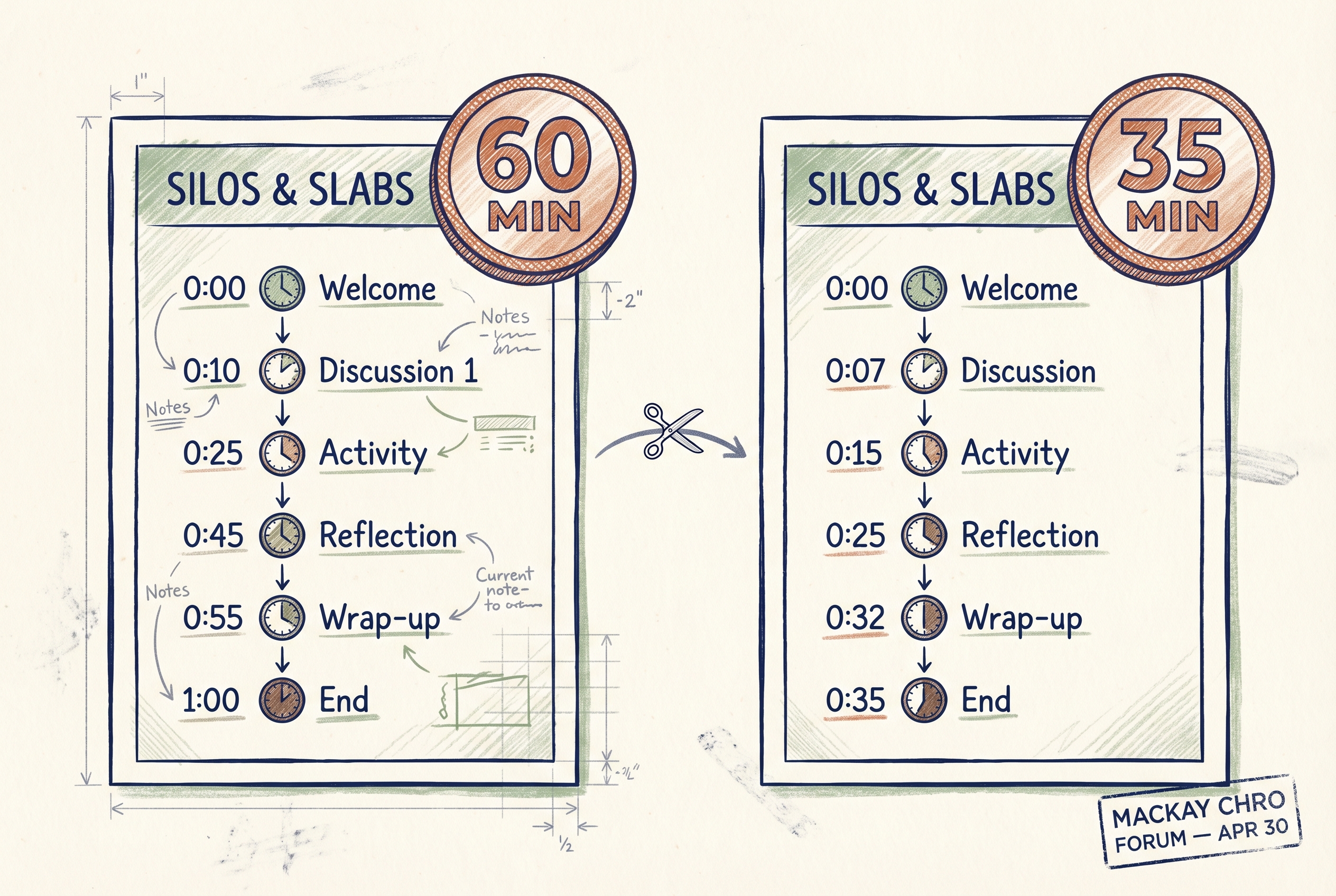
A training module, shortened on demand
Another CoachingOurselves automation, at the document level.
Read the story →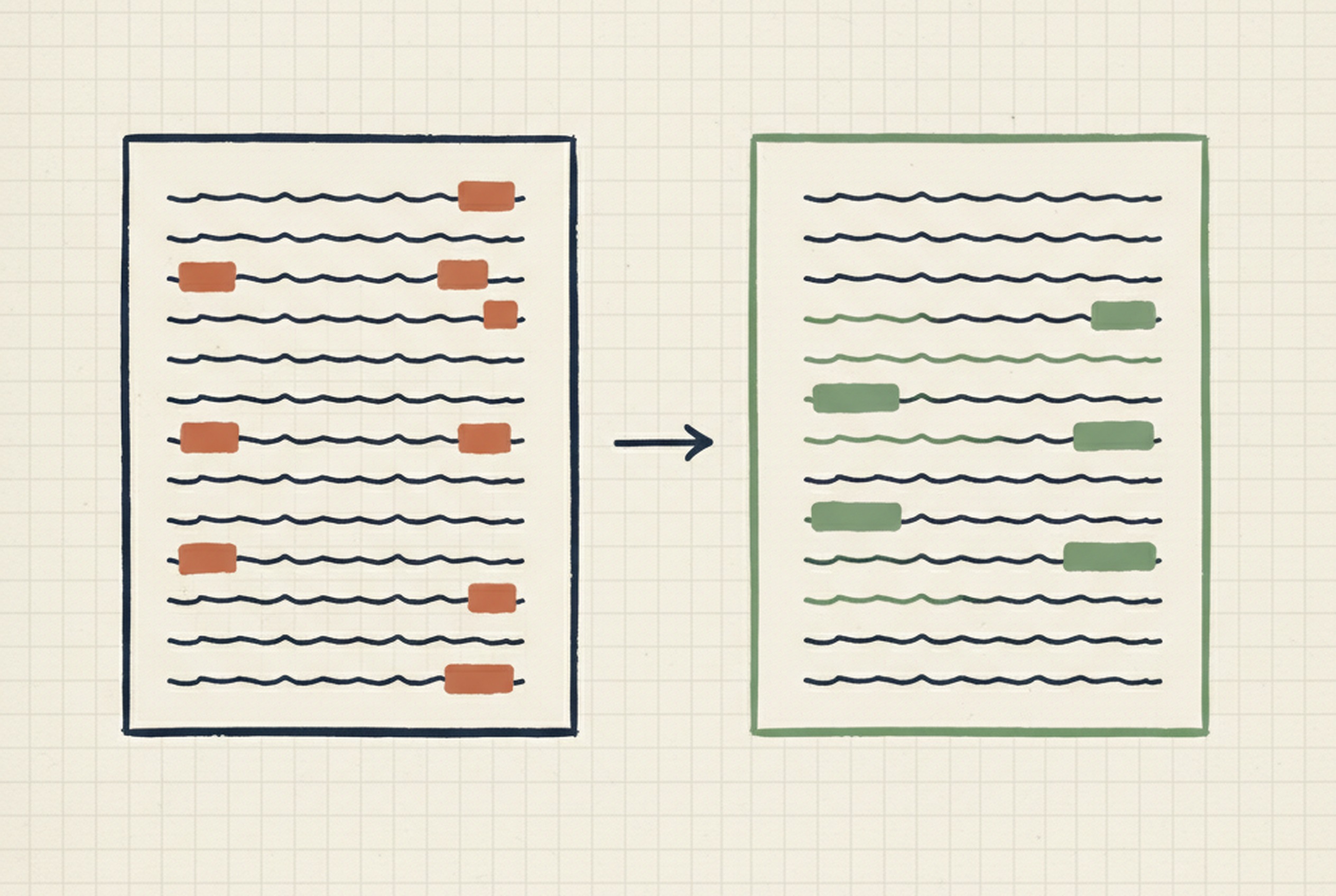
A transcript anonymizer that runs on your laptop
The same expert-knowledge-locked-in-text problem, different field.
Read the story →