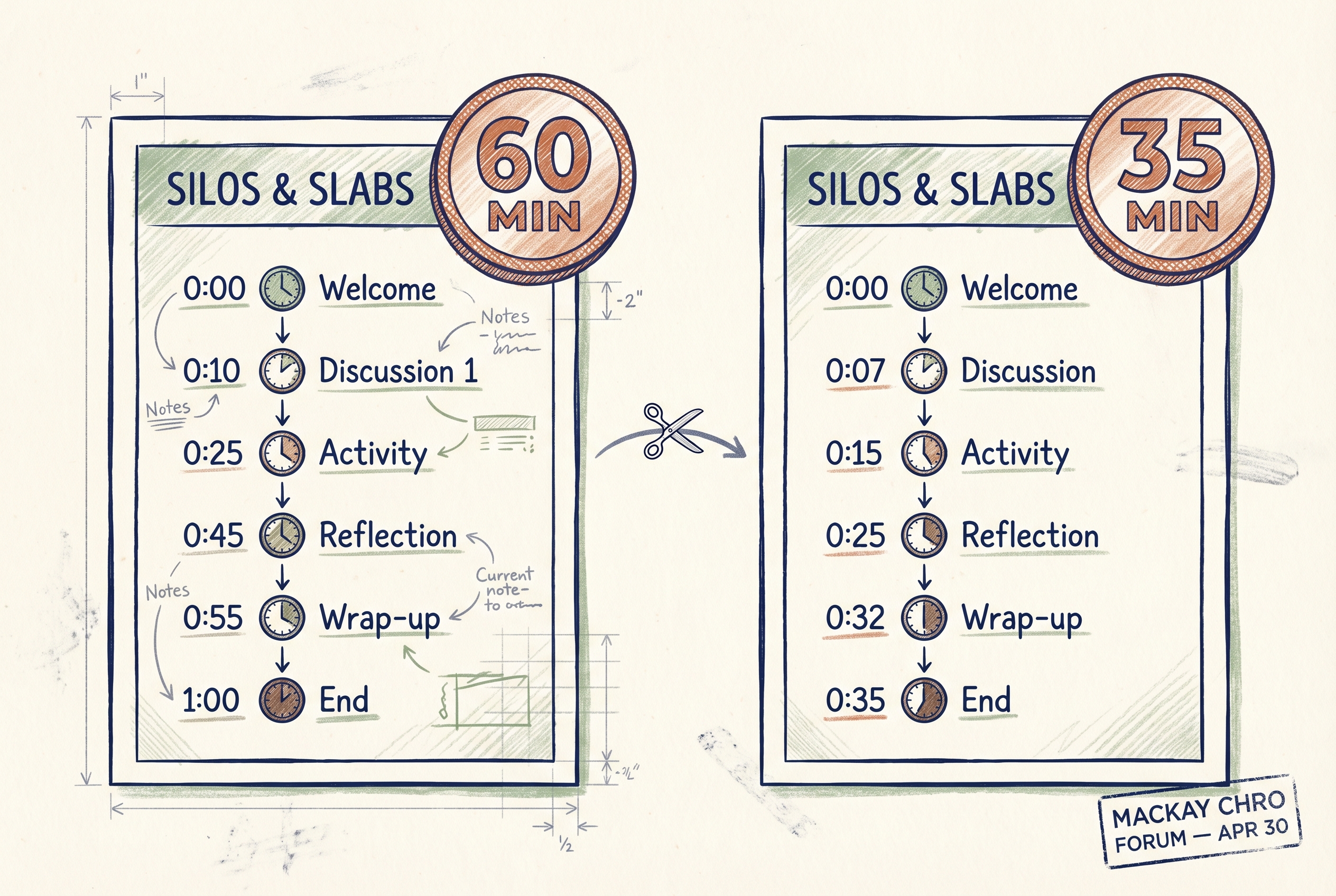
A training module, shortened on demand
Two production runs in the first month — MacKay CEO Forums' CHRO session and Alberta Health Services' APL team. Same cutting protocol, two very different pipelines.
What this could do for your organization
If your organization publishes training, workshop content, or long-form editorial that gets repurposed — a library of 90-minute workshops that clients sometimes want as 45-minute versions; a 120-page curriculum that needs a one-hour conference cut; a multi-module program tailored to the two hours a particular client has — this is the shape of what I do. I take the long-form original and produce a shortened, structurally-coherent version: pagination renumbered, agendas rebuilt from the kept sections, progress bars redrawn to the new scale, orphan references to cut content swept out. Everything that would otherwise drift quietly stays tight.
The practical effect: the custom-length version clients sometimes want but never ask for because they know what it costs to make — the tailored cut for a specific event, the offsite-length variant, the lunchtime briefing — becomes something your team can say yes to routinely, in hours instead of the full day of careful hand-editing a cut used to require.
What your team gets back
If you're already a CoachingOurselves customer running an event, you can request a custom-length cut by email or on a Teams planning call. What comes back is a print-ready shortened topic tailored to your event, a participant handout, and a slide deck your host can use to introduce the topic and run the session. The transcript of the Teams call (if that's how you brief) is what drives the editorial decisions — no separate spec document needed. It's a delivered output, not a setup.
If you run your own training organization or publish long-form content that needs repurposing across formats, the delivery is different: I help you stand up a customized version of this protocol that your team owns and runs. The cutting rules get tailored to your content format (CoachingOurselves has eleven; yours will be different), the pipeline gets wired into how your content is laid out, and your production team can cut modules to custom lengths on their own going forward. The first engagement is the standup; after that, you don't need me.
How I did it
CoachingOurselves publishes 93 peer-learning modules — 60 to 90 minutes each, built for a small group of managers and a live conversation. Occasionally a client needs a shortened version for a specific event. Shortening one by hand is a full day of concentration you cannot interrupt without losing your place. I wrote down the rules, turned them into a script, and in the first month the tool ran twice: a 35-minute Mintzberg module for MacKay CEO Forums and a 45-minute culture session for 140 people at Alberta Health Services.
On the first run, I decided which sections to cut. On the second run, my Claude analyzed a transcript of the conversation I'd had with the client about what they needed, and my Claude decided which sections to keep and which to cut. The script handled the cutting and everything downstream of that decision either way.
The mundane part: every kept page has to be relabeled and its progress bars redrawn at the new scale.
The agenda spread gets rebuilt from the kept-section list. The numbers have to add up exactly.
Eleven cutting rules, written down once and reusable across any module. The script runs them on a new module in minutes instead of the full day of careful hand-editing the work used to take.
- 01Never cut the cover, agenda, or readings — they are structural.
- 02Cut long-exercise pages before reading pages — highest time per idea.
- 03Kept pages keep their original time — the group still needs those minutes.
- 04The agenda shows the exact sum of page times, not the event slot.
- 05Rewrite the elapsed and remaining counters on every kept page.
- 06Redraw the three proportional progress bars at the new scale.
- 07Rebuild the agenda spread from the kept-section list.
- 08Rewrite the topic-overview bullets to match.
- 09Sweep every kept story for orphaned references to cut sections.
- 10Repack the source file.
- 11Review every page in the editor, then export the PDF.
Two production runs in one month. Same protocol, two completely different pipelines into it.
The second run was more automated. Alberta Health Services needed a shortened culture module for 140 people. A week before the event, I held a 23-minute planning call with their OD team. The call was transcribed. I dropped the transcript into my workspace and Claude read it end-to-end — including the moments when I addressed Claude directly, out loud, while the client was on the line. My counterpart said, "It's so interesting. I'm like, who's listening?" From that single transcript, Claude wrote the content plan, applied editorial judgment to a cut suggestion the client had brought, edited the IDML XML, and generated two companion deliverables — a facilitator slide deck and a fillable takeaway worksheet.
If you publish training or editorial content that has to be recut for different formats without losing its structure, drop me a line and we'll figure out what it would take.
Related projects
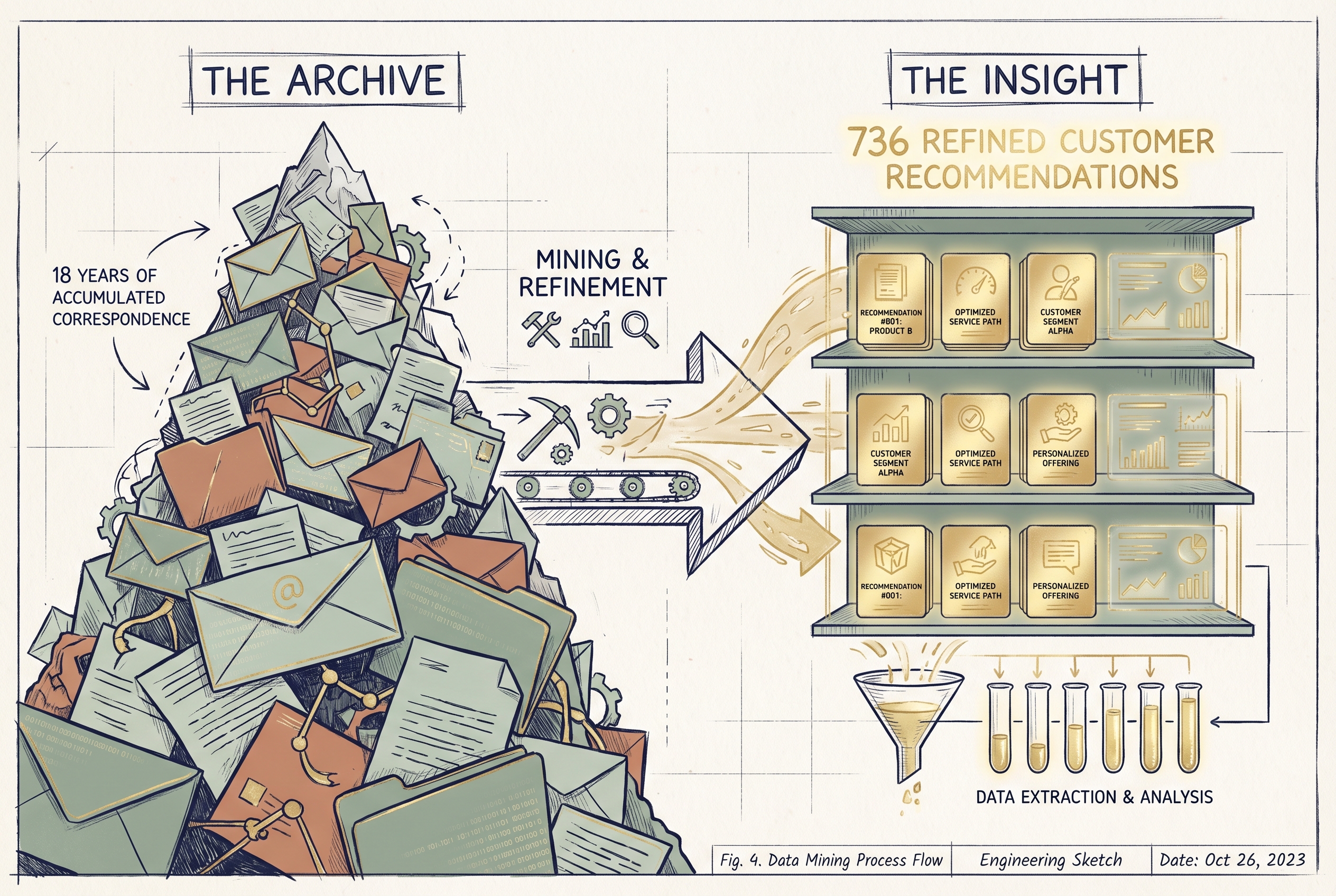
Eighteen years of email, turned into a pattern library
The other CoachingOurselves story. Same "important but mundane" thread.
Read the story →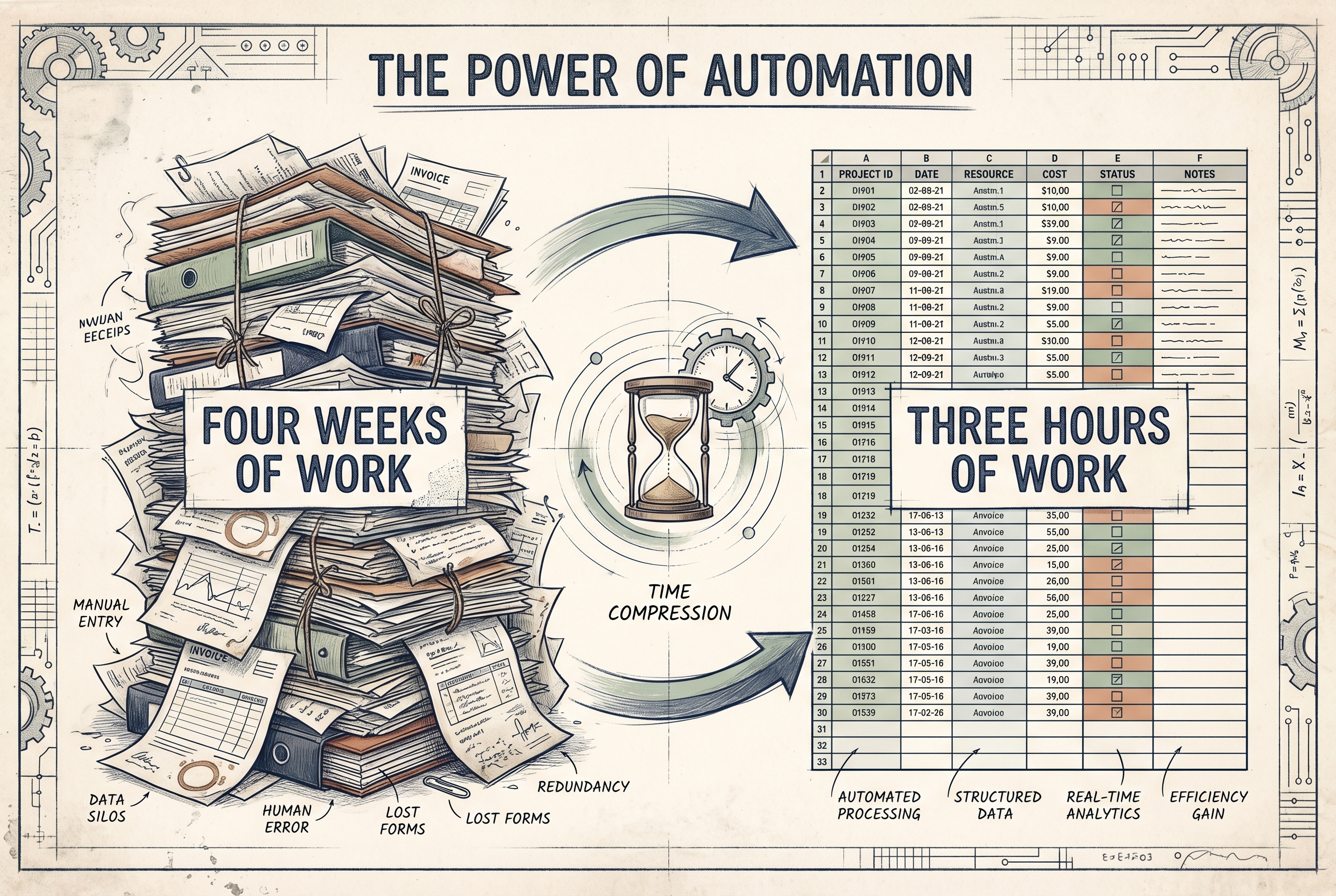
A month of work, three hours of work
Another method built from written rules, then automated.
Read the story →
Automated website redesigns
Rules-first pipeline, applied to a different kind of document.
Read the story →